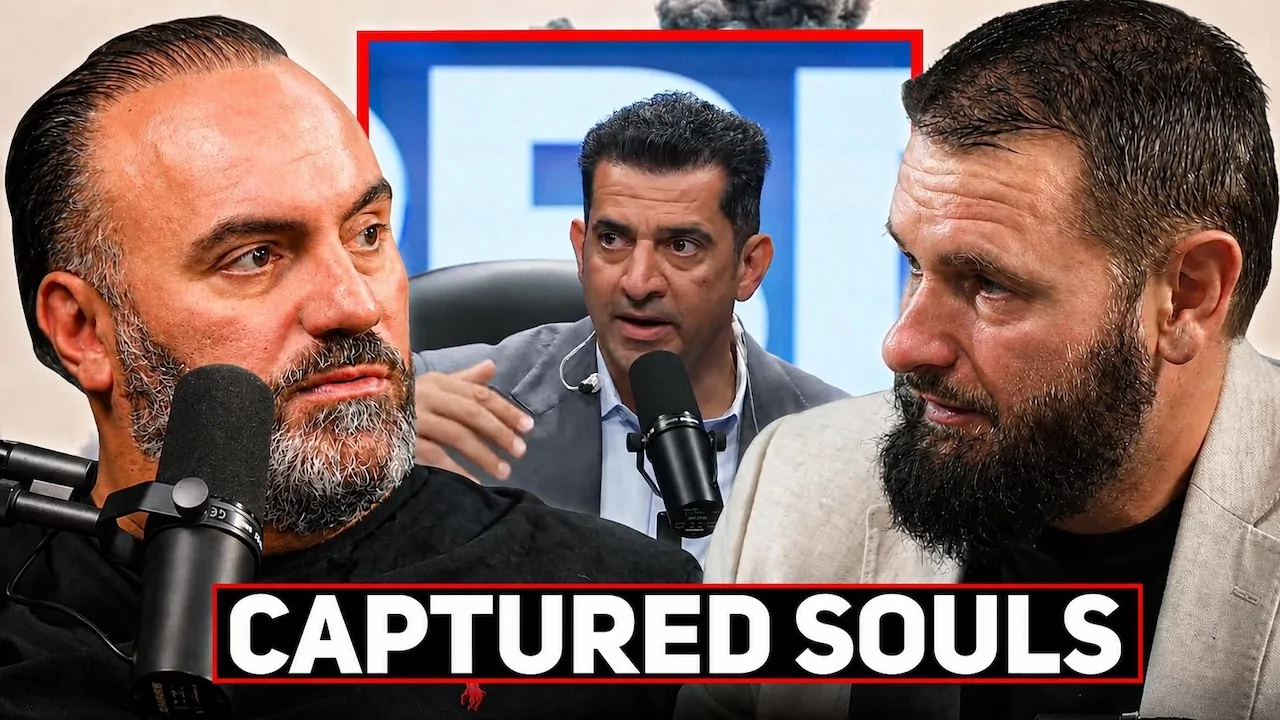
When one of America’s most-followed business podcasters begins labeling Muslims as spiritually “captured” and implying they serve the devil, the Muslim community cannot afford silence. In Episode 1188 of TheDeenShow, host Eddie sits down with Bek Lover — a Muslim of Albanian-Bosnian heritage whose clarity, passion, and knowledge of Islamic theology, comparative religion, and modern geopolitics make this one of the most substantive responses to anti-Islam media narratives in recent memory. The conversation moves swiftly from Patrick Bet-David’s inflammatory rhetoric to the corruption of scripture, the logical impossibility of the Trinity, Paul’s transformation of early Christianity, and the blood-soaked history of Muslim lands in Bosnia and Albania — weaving together faith, purpose, and historical truth in a way that demands the attention of every Muslim and every honest seeker of guidance.
Captured Souls and Double Standards: Holding Patrick Bet-David’s Rhetoric Accountable
The episode opens with a clip from the PBD Podcast in which a guest suggests that anyone not “serving Jesus Christ” is — whether knowingly or not — a soldier for the devil, their soul spiritually captured. The intended target is unmistakable. Bek Lover’s response is sharp and principled: by this same theological standard, PBD’s own Jewish co-host, who does not follow Christ, would fall under the identical accusation — yet no one on the show raised that point. The hypocrisy is self-evident. But rather than responding with outrage, Bek Lover opens with accountability, reminding the audience that in Islam every word carries weight before Allah. “If I give you the wrong information and that brings you to some type of conclusion,” he states plainly, “I am responsible — because information is the most powerful thing a human being can possess.” That sense of spiritual seriousness is precisely what is missing from PBD’s platform. Eddie and Bek go further, contextualising PBD’s deep antipathy toward Islam through his family’s experience fleeing the Iranian Revolution — but they challenge his framing directly: it was not Islam but documented CIA intervention in the 1953 Iranian coup (Operation Ajax) that toppled a secular government and ultimately paved the path for the Ayatollah. Blaming the faith of 1.8 billion believers for the geopolitical engineering of Western intelligence agencies is not analysis — it is misdirection.
“Over and over, our book commands us to seek shelter in God — from the devil. We seek refuge in God from the cursed devil. God doesn’t pray. God gets prayed to — and these are questions that cannot be answered unless someone is being honest with themselves.”
- PBD’s guest argued that anyone not serving Christ is a “captured soul” — a claim that equally condemns PBD’s own Jewish co-host, a contradiction left entirely unaddressed on his platform.
- Muslims begin every action in God’s name and formally seek refuge in Allah from Shaytan before reciting the Quran — the direct theological opposite of devil worship.
- Bek Lover explicitly models Islamic accountability: he is not an imam or scholar, invites his audience to fact-check everything he says, and welcomes correction — because ego has no place in spreading knowledge of the deen.
- The CIA’s role in the 1953 Iranian coup is declassified public record — PBD’s anger at the Islamic Revolution, if honest, should be directed at the agencies that destabilised Iran, not at Islam itself.
- Patrick Bet-David’s “soft touch” toward certain political allies while amplifying criticism of Islam is a pattern of selective outrage that audiences across the political spectrum are increasingly recognising for what it is.
God Does Not Pray to Himself: The Theological Case Scripture Cannot Refute
The episode’s theological depth reaches its peak when Bek Lover lays out a challenge rooted in the Old Testament itself: Exodus 33:20, in which God tells Moses that no human being can see His face and live. If Jesus was God — as mainstream Christianity claims — then Jesus wrote the Old Testament. But the God of the Old Testament explicitly states He cannot manifest in human form without destroying the observer. This is not a polemic; it is a logical impossibility that Christian apologists have never satisfactorily resolved. Bek Lover drives the point further: in Matthew 26:36–39, Jesus prostrated with his face to the ground in prayer, begging to be saved from what awaited him. A God does not pray to Himself. A God does not hide from pursuers, because an omniscient being would know capture was inevitable regardless. These questions arise directly from reading the very texts Christianity asks the world to accept as divine truth. The conversation then turns to Paul — who never met Jesus, who was actively massacring the first followers of Christ, and who, following a vision of a “being of light” on the road to Damascus, went on to write nearly 30% of the New Testament. Islam teaches that the devil can shapeshift; Christian scripture itself warns that the devil appears as an angel of light. The Ebionites, among the earliest followers of Christ, recognised him as Messiah but not as God — and they were hunted to extinction. Meanwhile, the Quran was revealed as the final, uncorrupted word of Allah: preserved in Arabic, memorised in its entirety by millions across every generation, unchanged since the time of the Prophet Muhammad ﷺ. When linguists acknowledge that translation loses 20–40% of original meaning at each conversion — and the Bible has passed from Aramaic through ancient Greek, Latin, and then English — the Quran’s singular preservation is not a theological footnote but a living miracle. Bosnia and Albania add a geopolitical dimension that grounds these spiritual arguments in lived Muslim experience: mosques were systematically demolished while churches stood, American forces trained the Bosnian Serb military, and $1.6 billion in arms deals were signed and delivered — facts that most of the world, including much of the Muslim community, has never been taught.
- Exodus 33:20 states that no human can see God’s face and live — directly contradicting the claim that God became a man and walked visibly among people for decades.
- Jesus prayed prostrated to the ground in Matthew 26, in the same posture as Muslim salah, begging to be spared — the act of a servant before his Lord, not of God Himself.
- Paul wrote roughly 30% of the New Testament yet never met Jesus, was actively persecuting early Christians before his Damascus vision, and is never classified as a prophet in Christianity — despite allegedly receiving direct communication from Christ.
- The Catholic and Protestant Bibles differ fundamentally — with entire books and chapters removed — representing distinct “versions,” not mere interpretive translations.
- The Quran is preserved in one Arabic original; Muslims worldwide — Bosnian, Albanian, Arab, or otherwise — pray in the same Arabic, not because Arabs are superior, but because the word of Allah must remain intact and undivided.
- In Bosnia, mosques were targeted for destruction while churches survived — a documented pattern of religious and cultural erasure that the Western media landscape has largely refused to confront with honesty.
“If the Israelites had transmitted the message God sent through them — that there is only one God — it was the same message from Adam all the way to Christ, peace be upon him. They mocked the prophets of God. They changed the books of God. That is where the deviation came from.”
What this episode ultimately offers is not hostility toward Christians or Jews, but a firm, documented, spiritually grounded refusal to accept false narratives about Islam and Muslims. Bek Lover and Eddie are not engaging in “us versus them” — they are holding a mirror to those who spread misinformation while claiming the moral high ground. Every Muslim who engages with this conversation is reminded of a foundational principle of the deen: we are accountable before Allah for every word we speak, every claim we amplify, and every opportunity to share honest guidance that we either seize or abandon. The greatest act of dawah is not a heated argument — it is the humble, intellectually courageous act of presenting truth and inviting others, Muslim and non-Muslim alike, to verify it for themselves. In a world increasingly shaped by captured media, captured algorithms, and perhaps — as this episode provocatively raises — captured souls, the anchor of the believer remains unchanged: there is no God but Allah, and to Him alone we bow our heads and our hearts.